
March 4, 2026
The American Public Transportation Association (APTA) has released an Economic Impact of Public Transportation Investment study, an independent analysis highlighting what investments in public transportation can materialize into. The study’s release comes ahead of the 2026 Surface Transportation Reauthorization process.
The report comes as a supplement to APTA’s Surface Transportation Authorization Recommendations, which it began pursuing last year. The recommendations urge Congress and the Trump Administration to build upon current investment made in public transit and passenger rail through the existing surface transportation authorization bill—the Infrastructure Investments and Jobs Act (IIJA)—by providing $138 billion for public transit and $130 billion for passenger rail over the next five years.
APTA calls for this continued investment based on the findings of the economic impact analysis, citing that for every $1 billion invested in public transportation, $5 billion is generated in long-term economic value and supports jobs nationwide. That job support works out to $3.1 billion in earned wages for every $1 billion invested in public transit, according to the report.
In a webinar hosted by APTA on March 3, association President and CEO Paul Skoutelas noted that the decisions that are currently being made by Congress will “strengthen the economy for years to come” and that the report “ensures that transit has a seat at the table.”
The report finds that investment in public transportation delivers what APTA says are strong taxpayer returns. $1 billion in public transit investment yields 41,400 jobs created or sustained, $251 million generated in tax revenue and $3.6 billion of value is realized in improved access to jobs and healthcare, reduced congestion and lower household transportation costs.
APTA says that the study finds that if Congress adopts its recommendations, the result will be nearly $140 billion in annual impacts on the economy compared to baseline investment levels.
The association notes that federal investment allows public transit agencies to address the more than $150 billion state-of-good-repair backlog, meet growing mobility demands and drive new technologies to enhance safety and security.
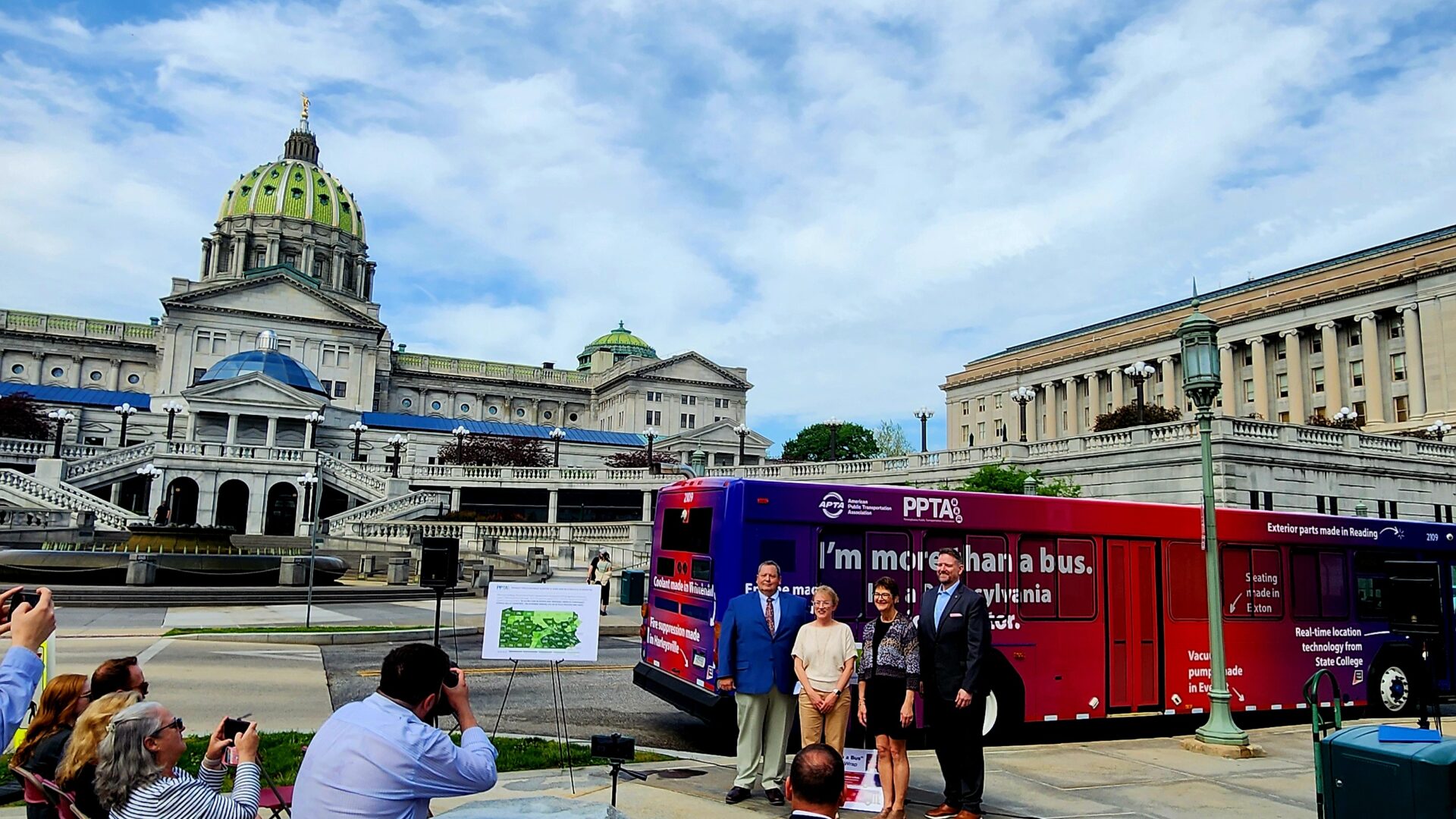
Other APTA research finds that nearly 80% of federal public transit funds flow to the private sector, providing support for American manufacturing and family-wage jobs. APTA has also released updated bus manufacturing and rail car manufacturing schematics breaking down how federal investments in public transit support 3,000 suppliers in more than 1,700 communities in all 50 states.
According to APTA Business Members Board of Governors Chair and STER Seating President Raymond Melleady, federal funding for transit does not end at the federal level.
“At STER Seating, we’ve seen first-hand how public transit investments impact the private sector,” Melleady said. “Every dollar invested in public transportation supports a web of manufacturers for both small and big businesses.”
APTA says its recommendations for the next surface transportation law are guided by three key initiatives:
- Build upon current investment for public transit and passenger rail to drive job creation, innovation and economic growth.
- Accelerate project delivery by eliminating statutory and regulatory barriers to building infrastructure.
- Strengthen collaborative, local decision-making.
While APTA’s ask for public transit funding is a $30 billion increase from funding levels set out in the IIJA, the association says that the increase would restore agency’s purchasing power that’s been eroded by inflation over the past five years.
Skoutelas noted that the report features an updated look at ridership trends that have transpired since the COVID-19 pandemic and that those trends should impact the surface reauthorization. He also notes that since fiscal year 2022, ridership across the U.S. has grown year-after-year.
APTA Board Chair and Executive Director for the Regional Transportation Authority in Chicago Leanna Redden echoed Skoutelas’s optimism on ridership.
“In Chicago, while ridership hasn’t fully come back [to pre-pandemic levels], we’ve seen double digit ridership increase every year post pandemic,” Redden said.